Establishment and Constitution of the Supreme Court
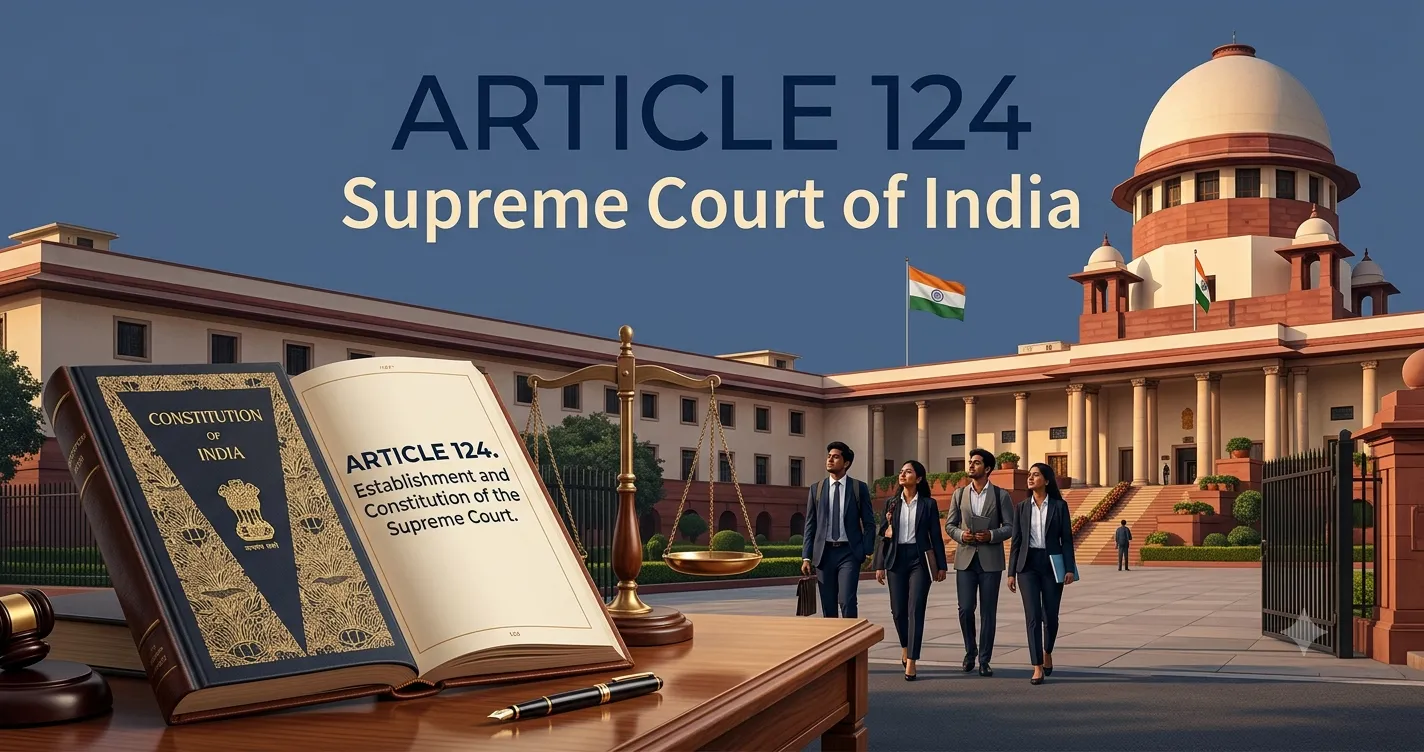
What is Article 124?
Article 124 establishes the Supreme Court of India and sets out important constitutional provisions concerning its composition and judges. The Supreme Court consists of the Chief Justice of India and other Judges. Parliament may by law prescribe a larger number of Judges. The present statutory limit is thirty-three other Judges in addition to the Chief Justice of India. Article 124 also provides qualifications for appointment as a Supreme Court Judge. A person must be a citizen of India and must satisfy one of the constitutional requirements relating to experience as a High Court Judge, experience as an advocate of a High Court, or being a distinguished jurist in the opinion of the President. The Article provides that Supreme Court Judges hold office until the age of sixty-five years. It also provides for resignation and establishes the constitutional procedure for removal of a Judge. Removal is subject to a special parliamentary procedure. It requires an address by each House of Parliament supported by the required majorities and is based on proved misbehaviour or incapacity. Article 124 therefore provides the constitutional foundation for the Supreme Court's composition, appointment qualifications, tenure, resignation, removal and oath of office.
This content is a sample educational structure. Please verify all constitutional text against an authoritative source before relying on it.
Official Constitutional Text
Establishment and constitution of Supreme Court.—(1) There shall be a Supreme Court of India consisting of a Chief Justice of India and, until Parliament by law prescribes a larger number, of not more than thirty-three other Judges. (2) Every Judge of the Supreme Court shall be appointed by the President by warrant under his hand and seal after consultation with such of the Judges of the Supreme Court and of the High Courts in the States as the President may deem necessary for the purpose and shall hold office until he attains the age of sixty-five years: Provided that in the case of appointment of a Judge other than the Chief Justice, the Chief Justice of India shall always be consulted: Provided further that— (a) a Judge may, by writing under his hand addressed to the President, resign his office; (b) a Judge may be removed from his office in the manner provided in clause (4). (2A) The age of a Judge of the Supreme Court shall be determined by such authority and in such manner as Parliament may by law provide. (3) A person shall not be qualified for appointment as a Judge of the Supreme Court unless he is a citizen of India and— (a) has been for at least five years a Judge of a High Court or of two or more such Courts in succession; or (b) has been for at least ten years an advocate of a High Court or of two or more such Courts in succession; or (c) is, in the opinion of the President, a distinguished jurist. Explanation I.—In this clause “High Court” means a High Court which exercises, or which at any time before the commencement of this Constitution exercised, jurisdiction in any part of the territory of India. Explanation II.—In computing for the purpose of this clause the period during which a person has been an advocate, any period during which a person has held judicial office not inferior to that of a district judge after he became an advocate shall be included. (4) A Judge of the Supreme Court shall not be removed from his office except by an order of the President passed after an address by each House of Parliament supported by a majority of the total membership of that House and by a majority of not less than two-thirds of the members of that House present and voting has been presented to the President in the same session for such removal on the ground of proved misbehaviour or incapacity. (5) Parliament may by law regulate the procedure for the presentation of an address and for the investigation and proof of the misbehaviour or incapacity of a Judge under clause (4). (6) Every person appointed to be a Judge of the Supreme Court shall, before he enters upon his office, make and subscribe before the President, or some person appointed in that behalf by him, an oath or affirmation according to the form set out for the purpose in the Third Schedule. (7) No person who has held office as a Judge of the Supreme Court shall plead or act in any court or before any authority within the territory of India.
Article 124 Explained in Simple Words
Article 124 establishes the Supreme Court of India and sets out important constitutional provisions concerning its composition and judges. The Supreme Court consists of the Chief Justice of India and other Judges. Parliament may by law prescribe a larger number of Judges. The present statutory limit is thirty-three other Judges in addition to the Chief Justice of India. Article 124 also provides qualifications for appointment as a Supreme Court Judge. A person must be a citizen of India and must satisfy one of the constitutional requirements relating to experience as a High Court Judge, experience as an advocate of a High Court, or being a distinguished jurist in the opinion of the President. The Article provides that Supreme Court Judges hold office until the age of sixty-five years. It also provides for resignation and establishes the constitutional procedure for removal of a Judge. Removal is subject to a special parliamentary procedure. It requires an address by each House of Parliament supported by the required majorities and is based on proved misbehaviour or incapacity. Article 124 therefore provides the constitutional foundation for the Supreme Court's composition, appointment qualifications, tenure, resignation, removal and oath of office.
Article 124 in Simple Words
Article 124 establishes the Supreme Court of India and provides constitutional rules relating to its Judges, including their qualifications, tenure, resignation and removal.
Article 124 Example
Suppose a person is being considered for appointment as a Judge of the Supreme Court. The person must be an Indian citizen and must satisfy one of the constitutional qualification requirements, such as having the required experience as a High Court Judge or advocate, or being a distinguished jurist in the opinion of the President. For another example, if a Supreme Court Judge wishes to resign, the Constitution permits the Judge to submit a written resignation addressed to the President. If removal of a Judge is sought on the ground of proved misbehaviour or incapacity, the constitutional parliamentary procedure under Article 124(4) must be followed. A simple decision by one authority is not sufficient.
What is Article 124 of the Indian Constitution?
Article 124 deals with the establishment and constitution of the Supreme Court of India. It contains provisions concerning the composition of the Court and important matters relating to Supreme Court Judges.
What does Article 124 establish?
Article 124 establishes the Supreme Court of India as the constitutional apex court of the Union Judiciary. It provides that the Court consists of the Chief Justice of India and other Judges, subject to the number prescribed by Parliament.
Which Part contains Article 124?
Article 124 is contained in Part V of the Constitution, which deals with the Union. It appears in Chapter IV, titled the Union Judiciary.
How many Judges can the Supreme Court have?
Article 124 provides for the Chief Justice of India and a number of other Judges prescribed by Parliament. The current statutory maximum is thirty-three other Judges in addition to the Chief Justice of India.
What are the qualifications for a Supreme Court Judge?
A person must be a citizen of India and must satisfy one of the constitutional requirements: at least five years as a Judge of a High Court or two or more High Courts in succession, at least ten years as an advocate of a High Court or two or more High Courts in succession, or being a distinguished jurist in the opinion of the President.
What is the retirement age of a Supreme Court Judge?
A Judge of the Supreme Court holds office until attaining the age of sixty-five years. This age is specifically provided in Article 124(2).
Who appoints Supreme Court Judges?
Article 124 provides that every Judge of the Supreme Court is appointed by the President by warrant under his hand and seal. The constitutional text also contains consultation requirements concerning Judges of the Supreme Court and High Courts.
Can a Supreme Court Judge resign?
Yes. Article 124 permits a Supreme Court Judge to resign by writing addressed to the President.
How can a Supreme Court Judge be removed?
Article 124 provides a special constitutional procedure for removal. Removal requires an order of the President after an address by each House of Parliament supported by the required majorities, on the ground of proved misbehaviour or incapacity.
What majority is required for removal of a Supreme Court Judge?
The address must be supported by a majority of the total membership of the House and by a majority of not less than two-thirds of the members of that House present and voting. The address must be presented to the President in the same session.
What oath does a Supreme Court Judge take?
Before entering office, every person appointed as a Supreme Court Judge must make and subscribe an oath or affirmation before the President or a person appointed by the President, according to the form provided in the Third Schedule.
Can a retired Supreme Court Judge practise in courts in India?
No. Article 124(7) provides that a person who has held office as a Judge of the Supreme Court shall not plead or act in any court or before any authority within the territory of India.
Article 124 and judicial independence
Article 124 creates constitutional safeguards relating to the tenure, resignation and removal of Supreme Court Judges. The special removal procedure requires participation and prescribed majorities in both Houses of Parliament.
Article 124 and the Supreme Court of India
Article 124 is the foundational constitutional provision for the establishment and composition of the Supreme Court. Other Articles in Chapter IV deal with matters such as salaries, acting Chief Justice, jurisdiction, powers and procedures of the Supreme Court.
Article 124 in simple words
In simple words, Article 124 establishes the Supreme Court of India and explains the constitutional framework relating to its Judges, including their appointment, qualifications, retirement age, resignation, removal and oath.