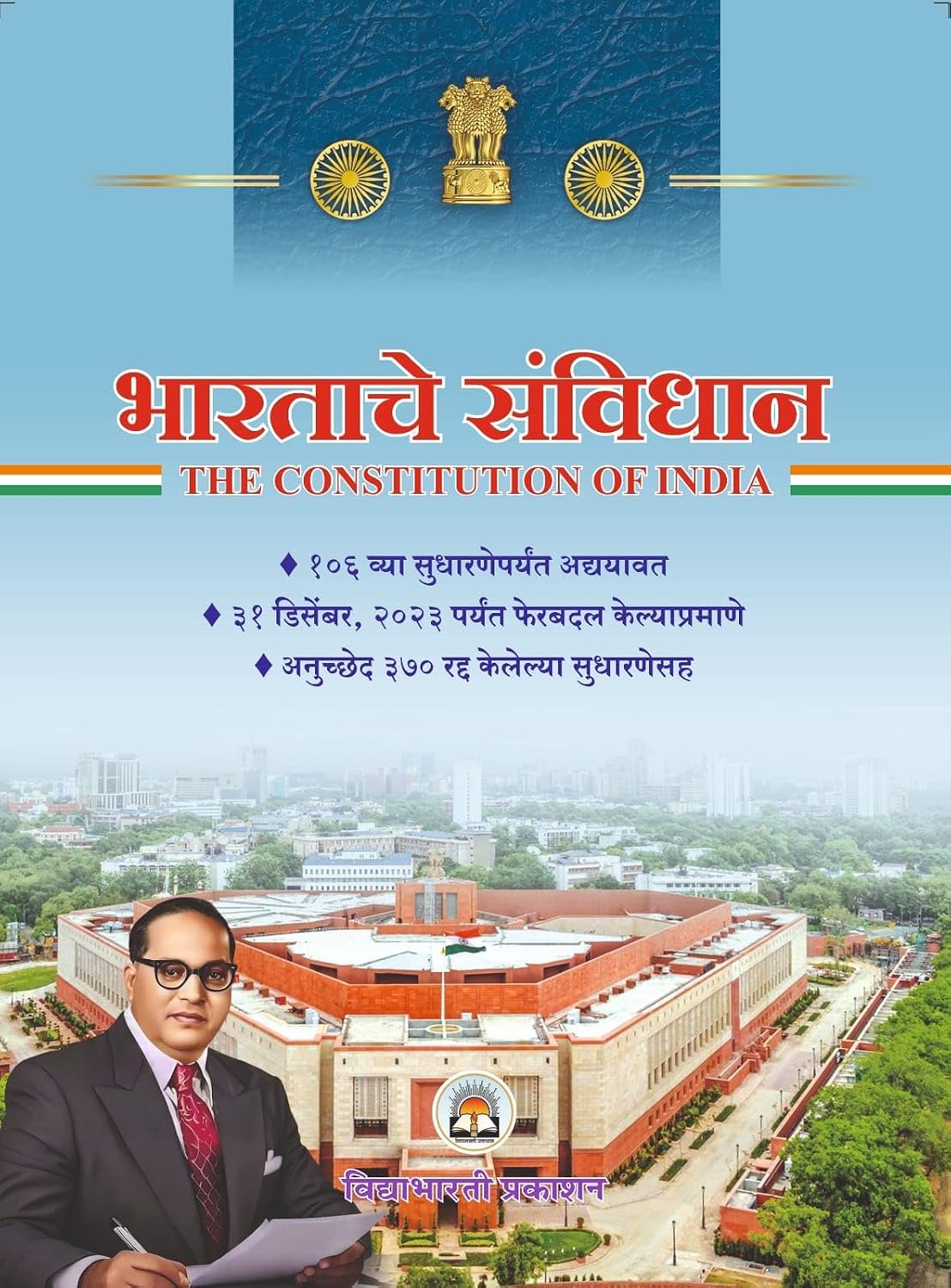
Indian Constitution · Marathi
The Constitution of India
Dr. Babasaheb Ambedkar
The Constitution of India in Marathi, updated up to the 106th Constitutional Amendment, including the amendment related to Article 370.
₹430
Buy NowExplore the Constitution of India and understand its Articles, Rights, Duties and Amendments in simple and easy language.
Explore Constitutional Articles and understand their meaning.
Understand your fundamental rights.
Know your duties as a citizen.
Learn about the principles guiding the government.
Explore important Constitutional Amendments.
Learn about landmark Supreme Court judgments.
Reading list
Indian Constitution · Marathi
Dr. Babasaheb Ambedkar
The Constitution of India in Marathi, updated up to the 106th Constitutional Amendment, including the amendment related to Article 370.
₹430
Buy Now
UPSC / MPSC · Marathi
M. Laxmikanth
Marathi edition for UPSC and MPSC exams, featuring 95 well-structured chapters, 40+ conceptual videos, 18 appendices and solved MPSC PYQs.
₹641
Buy NowArticle 14 is one of the Fundamental Rights guaranteed by the Constitution of India. It provides that the State shall not deny any person equality before the law or equal protection of the laws within the territory of India. The provision applies to every person, not only to citizens. This is important because the wording of Article 14 uses the expression "any person". It therefore protects individuals within the territory of India against unequal treatment by the State in matters covered by the constitutional guarantee. Article 14 contains two closely connected ideas: equality before the law and equal protection of the laws. Equality before the law reflects the principle that no person is above the law and that the law should not arbitrarily give one person a superior legal status over another. Equal protection of the laws focuses on providing equal legal protection to people who are similarly situated. Article 14 does not mean that every person must always be treated identically in every situation. Constitutional law can permit reasonable distinctions when there is a valid basis for treating different groups differently. The important question is whether the classification or distinction has a constitutionally acceptable basis and is connected with the purpose of the law. For this reason, Article 14 is not simply a rule saying "everyone must receive exactly the same treatment". It is a broader constitutional guarantee against arbitrary State action and unjustified unequal treatment.
View DetailsArticle 19 is one of the important provisions under the Right to Freedom in Part III of the Indian Constitution. It protects certain freedoms of Indian citizens and provides a constitutional framework within which these freedoms can be exercised. The Article protects freedom of speech and expression, peaceful assembly without arms, forming associations or unions or co-operative societies, free movement throughout India, residing and settling in any part of India, and practising a profession or carrying on an occupation, trade or business. These freedoms are important, but they are not expressed as completely unrestricted rights. The Constitution itself allows the State to impose reasonable restrictions in specified circumstances. The restrictions are different for different freedoms and must be connected with the grounds specifically mentioned in Article 19. For example, freedom of speech and expression is subject to restrictions relating to matters such as the sovereignty and integrity of India, security of the State, friendly relations with foreign States, public order, decency or morality, contempt of court, defamation and incitement to an offence. Similarly, the right to assemble peacefully may be subject to reasonable restrictions in the interests of the sovereignty and integrity of India or public order. The freedom to form associations can also be regulated on specified constitutional grounds. The freedoms of movement and residence may be subject to reasonable restrictions in the interests of the general public or for protecting the interests of Scheduled Tribes. The freedom to practise a profession or carry on a trade, occupation or business may also be regulated in the general public interest, including through requirements concerning professional or technical qualifications. Therefore, Article 19 establishes both individual freedoms and the constitutional framework for regulating those freedoms through specified reasonable restrictions.
View DetailsArticle 21 is one of the most important Fundamental Rights in Part III of the Indian Constitution. It protects the life and personal liberty of every person and places a constitutional requirement on the State when a person may be deprived of these interests. The wording of Article 21 is significant because it uses the expression "No person". Unlike some rights in Part III that are specifically available to citizens, Article 21 protects every person. Its protection therefore extends beyond Indian citizens. The Article states that no person shall be deprived of life or personal liberty except according to procedure established by law. This means that deprivation of life or personal liberty cannot simply be arbitrary; there must be a legally established procedure. The constitutional understanding of Article 21 has developed significantly through judicial interpretation. The protection is not limited to mere physical existence. The Supreme Court has interpreted Article 21 in relation to various aspects of a dignified life and personal liberty, while the exact scope of individual rights depends on constitutional interpretation and the facts of each case. Article 21 is also closely connected with other Fundamental Rights. Constitutional protections relating to equality, freedoms, criminal procedure, privacy, education, legal assistance and other aspects of personal liberty can interact with Article 21 depending on the circumstances. Therefore, Article 21 provides a broad constitutional protection for life and personal liberty and requires deprivation of these interests to follow a legally established procedure.
View DetailsArticle 32 is a provision in Part III of the Indian Constitution that provides a constitutional remedy for the enforcement of Fundamental Rights. It gives a person the right to approach the Supreme Court through appropriate proceedings when a Fundamental Right guaranteed by Part III needs to be enforced. Therefore, Article 32 is not merely about declaring Fundamental Rights; it provides a constitutional mechanism for seeking their enforcement. Under Article 32(2), the Supreme Court can issue directions, orders and writs for the enforcement of Fundamental Rights. The Constitution specifically mentions five types of writs: habeas corpus, mandamus, prohibition, quo warranto and certiorari. The five writs have different purposes. Habeas corpus is associated with protection against unlawful detention. Mandamus generally concerns the performance of a public legal duty. Prohibition is generally used to prevent a judicial or quasi-judicial authority from proceeding beyond its jurisdiction. Certiorari is generally concerned with reviewing the legality of proceedings or orders of a lower judicial or quasi-judicial authority. Quo warranto concerns the legal authority of a person to hold a public office. Article 32(3) provides that Parliament may by law empower another court to exercise some or all of the powers that the Supreme Court can exercise under Article 32(2), within that court's local jurisdiction. Article 32(4) states that the right guaranteed by Article 32 shall not be suspended except as otherwise provided by the Constitution. Article 32 therefore creates an important constitutional connection between Fundamental Rights and judicial remedies for their enforcement.
View DetailsCommon Questions
Quick answers to common questions about the Constitution of India.
The Constitution recognises 22 languages in its Eighth Schedule.